Top 10 Retinoids Compared: OTC vs Prescription Strength Ranked (2026)
By Dr. Mei Chen · Cosmetic Dermatologist & Senior Editor, The Exosome Edit
Updated Jun 2026Retinoids carry real risks during pregnancy and can trigger severe irritation. See a board-certified dermatologist before starting any prescription retinoid.
Quick Answer
- Tretinoin is the gold standard. Most data, most decades, most results.
- Adapalene 0.1% is the only OTC retinoid with Rx-strength FDA approval.
- Retinal is the strongest OTC option. About 10x more potent than retinol.
- Every retinoid is off-limits in pregnancy. Bakuchiol is the only safe swap.
Disclosure: this article contains affiliate links — we may earn a commission on qualifying purchases at no extra cost to you.
Last updated: May 2026
Medical Disclaimer: This article is educational. It is not medical advice.
Retinoids carry real risks during pregnancy and can trigger severe irritation. See a board-certified dermatologist before starting any prescription retinoid.
Affiliate Disclosure: The Exosome Edit may earn a small commission on linked products. Editorial picks are independent.
At a glance: 10 retinoids ranked
| Rank | Retinoid | OTC/Rx | Strength | Verdict |
|---|---|---|---|---|
| 1 | Tretinoin | Rx | 0.025-0.1% | Best overall, most data |
| 2 | Tazarotene | Rx | 0.045-0.1% | Strongest Rx for severe acne |
| 3 | Trifarotene | Rx | 0.005% | Best for truncal acne and scars |
| 4 | Adapalene 0.3% | Rx | 0.3% | Best Rx for moderate-severe acne |
| 5 | Adapalene 0.1% | OTC | 0.1% | Best OTC overall, gentlest start |
| 6 | Retinaldehyde | OTC | 0.05-0.1% | Best OTC for anti-aging |
| 7 | HPR | OTC | 0.1-0.2% | Best low-irritation option |
| 8 | Retinol | OTC | 0.25-1% | Best legacy anti-aging pick |
| 9 | Retinyl Palmitate | OTC | 0.5-1% | Weakest. Skip it for active concerns |
| 10 | Bakuchiol | OTC | 0.5-1% | Only pregnancy-safe alternative |
What we looked at
Retinoids are a family of vitamin A derivatives. They all converge on the same molecule in skin: retinoic acid.
Retinoic acid binds receptors that drive cell turnover and collagen synthesis. The further a compound sits from retinoic acid, the more conversion steps it needs.
More steps means more time and less potency (PMC, 2009). Tretinoin is retinoic acid. It works on contact.
Retinol takes two steps. Retinaldehyde takes one. Retinyl palmitate takes three.
Most dermatologists recommend tolerance escalation: start low, apply every third night, build to nightly over 6-8 weeks (JAAD, 1998). Skipping that ramp produces the "retinoid uglies" that drive most users to quit before week 12.
One non-negotiable: pregnancy. All true retinoids carry teratogenic risk (JDD, 2016). Bakuchiol is the only entry on this list cleared for pregnancy use.
1. Tretinoin — Gold Standard Rx (Verdict: Best overall, most data)
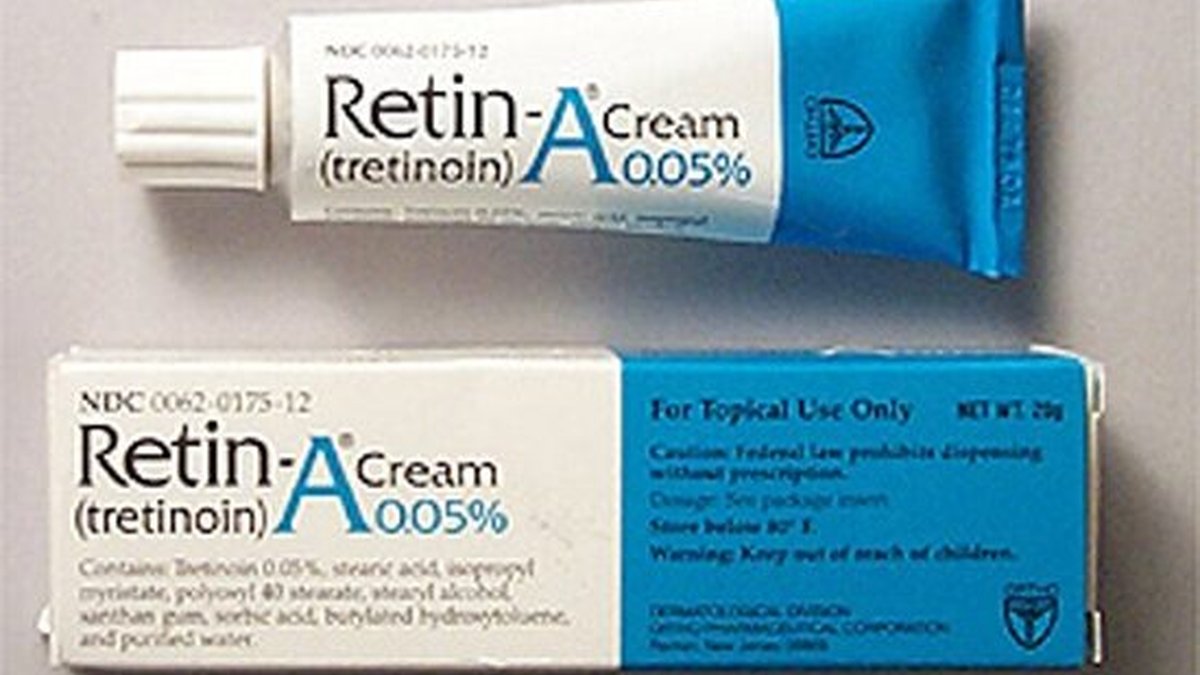
Tretinoin (Retin-A) is all-trans retinoic acid. It binds retinoid receptors directly, so it works without conversion.
Kligman's foundational 1986 work first proved tretinoin reverses photoaging (ScienceDirect, 1986). A landmark 1993 NEJM study measured new collagen formation in photodamaged skin after 10-12 months (NEJM, 1993).
A 2025 network meta-analysis ranked tretinoin highest for fine wrinkles and hyperpigmentation across all topical interventions (Nature, 2025).
Strengths: 0.025%, 0.05%, 0.1% cream and gel. Generic tretinoin runs $15-30/month via GoodRx.
Best for: photoaging, mild-to-moderate acne, hyperpigmentation. Time to result: 12-16 weeks for wrinkles.
Irritation tier: high. Expect dryness, peeling, redness for 4-6 weeks.
Pregnancy: contraindicated. Animal studies show teratogenic effects at high doses (Drugs.com, 2024).
2. Tazarotene — Strongest Rx for Severe Acne (Verdict: Strongest Rx for severe acne)
Tazarotene (Tazorac, Arazlo) is a third-generation retinoid that binds RAR-beta and RAR-gamma receptors with high selectivity. It is more potent than tretinoin gram for gram.
FDA-approved for plaque psoriasis (1997) and acne (1997). Arazlo lotion 0.045% was approved December 2019 (PRNewswire, 2019).
Two Phase 3 trials with 1,614 patients showed Arazlo significantly reduced inflammatory and noninflammatory lesions vs vehicle (Medscape, 2019).
A 2002 JAAD trial found 0.1% tazarotene cream outperformed both adapalene 0.1% gel and tretinoin 0.025% in reducing acne lesion counts (JAAD, 2002).
Best for: moderate-to-severe acne, plaque psoriasis. Time to result: 8-12 weeks.
Irritation tier: highest of all Rx retinoids.
Pregnancy: Category X. Absolutely contraindicated. Pregnancy test required before prescribing (JCAD, 2020).
3. Trifarotene — Best for Body Acne and Scars (Verdict: Best for truncal acne and scars)
Trifarotene (Aklief) is a fourth-generation retinoid selective for RAR-gamma. It was the first new retinoid molecule FDA-approved in over 20 years.
FDA-approved October 4, 2019 at 0.005% (Galderma, 2019). Phase 3 trials (PERFECT 1 and 2) enrolled 2,420 patients. Trifarotene is the first topical studied for both facial and truncal acne (Dermatology Times, 2019).
A 2023 Phase 4 split-face trial showed trifarotene reduced atrophic acne scars by 5.9 vs 2.7 with vehicle at week 24 (Springer, 2023).
Best for: chest, back, shoulder acne, atrophic scarring. Time to result: 8-12 weeks.
Irritation tier: moderate-high. Skin tightness in 1.7% of users.
Pregnancy: contraindicated. Same risk class as other Rx retinoids.
4. Adapalene 0.3% — Rx Strength (Verdict: Best Rx for moderate-severe acne)
Adapalene 0.3% (Epiduo Forte when combined with benzoyl peroxide) is the prescription strength of the OTC favorite.
In a 503-patient trial of moderate-to-severe inflammatory acne, the adapalene 0.3% / BPO 2.5% combo met success endpoints with 90.7% of patients reporting moderate-to-complete improvement at week 12 vs 40% on vehicle (PMC, 2016).
The 24-week OSCAR trial showed 64.2% of treated patients achieved clear or almost clear skin vs 19.4% on vehicle (Galderma).
A split-face JAAD study found adapalene 0.3% gel and tretinoin microsphere 0.04% had similar efficacy with adapalene better tolerated (JAAD, 2004).
Best for: moderate-to-severe acne, especially with comedones. Time to result: 8-12 weeks.
Irritation tier: moderate. Less than tretinoin or tazarotene.
Pregnancy: avoid. No human data, animal studies inconclusive.
5. Adapalene 0.1% — Best OTC (Verdict: Best OTC overall, gentlest start)
Adapalene 0.1% (Differin) is the only OTC retinoid with prescription-strength FDA approval.
Differin Gel 0.1% was approved for OTC sale on July 15, 2016 (Galderma, 2016). The FDA Advisory Committee voted 16-0 on safety. It costs about $15 for 0.5 oz on Amazon.
A landmark JAAD comparison trial showed adapalene 0.1% gel matched tretinoin 0.025% gel in efficacy with significantly less irritation (JAAD, 1997).
Best for: mild-to-moderate acne, first-time retinoid users. Time to result: 8-12 weeks.
Irritation tier: low. Best-tolerated Rx-strength molecule.
Pregnancy: avoid, though absorption is minimal.
6. Retinaldehyde — Strongest OTC for Aging (Verdict: Best OTC for anti-aging)
Retinaldehyde (retinal) is one conversion step away from retinoic acid. That makes it the most bioavailable OTC retinoid.
A 1998 study comparing 0.05% retinaldehyde to 0.05% retinoic acid (tretinoin) found both significantly reduced wrinkles and roughness with no statistical difference (ScienceDirect, 1998). Retinaldehyde caused significantly less irritation.
A 2025 six-week study of 0.1% retinaldehyde concentrate showed significant photoaging improvement (MDPI, 2025). A 2024 retinaldehyde-peptide serum trial confirmed texture and photoaging gains (PubMed, 2024).
Strengths: 0.05% to 0.1% in most serums. Avene RetrinAL runs $40-60. Medik8 Crystal Retinal lines up at $89-120.
Best for: anti-aging, sensitive-skin users who can't tolerate Rx. Time to result: 8-12 weeks.
Irritation tier: low-moderate. About 10x more potent than retinol with similar tolerability.
Pregnancy: avoid. Same retinoid class warning applies.
7. HPR — Low-Irritation Option (Verdict: Best low-irritation option)
Hydroxypinacolone retinoate (HPR), marketed as Granactive Retinoid, binds receptors directly without conversion. HPR shows similar affinity to tretinoin with significantly less irritation (Caroline Hirons, 2024).
A 2023 nanoparticle study confirmed anti-wrinkle efficacy with a low irritation profile (PMC, 2023). A 2025 trial using a retinol + HPR + peptide serum showed photoaging improvement (PMC, 2025).
Strengths: 0.1% to 0.2% HPR in most serums. The Ordinary Granactive Retinoid 2% Emulsion runs $9.80.
Best for: sensitive skin, rosacea-prone users, retinoid newcomers. Time to result: 12-16 weeks.
Irritation tier: very low. Comparable to retinyl esters.
Pregnancy: avoid as a precaution. Limited data, but it activates the same receptors.
8. Retinol — Legacy OTC (Verdict: Best legacy anti-aging pick)
Retinol is two conversion steps from retinoic acid. It is the most-studied OTC retinoid in cosmetics.
A 2024 vehicle-controlled integrated analysis of 0.1% stabilized retinol showed photoaging improvements as early as week 4, sustained through week 12 (JDD, 2024).
A 2017 head-to-head trial compared 1.0% retinol cream against 0.025% tretinoin cream. The retinol arm showed significant fine line reduction at all time points through 12 weeks (Wiley, 2017).
Strengths: 0.25%, 0.5%, 1% in most serums. CeraVe Resurfacing Retinol runs $20. SkinCeuticals Retinol 1.0 lists at $88.
Best for: anti-aging, mild texture issues, retinoid newcomers. Time to result: 12-24 weeks.
Irritation tier: moderate. Less than tretinoin, more than retinaldehyde.
Pregnancy: avoid. Same vitamin A derivative concerns.
9. Retinyl Palmitate — Weakest OTC (Verdict: Weakest. Skip it for active concerns)
Retinyl palmitate is a vitamin A ester three conversion steps from retinoic acid. It is the least potent topical retinoid available.
The three-step conversion to retinoic acid loses potency at each stage (Skin Wellness Dermatology, 2024). A 1% retinyl palmitate product is roughly equivalent to 0.2% retinol.
A 2020 retinyl ester study confirmed retinyl propionate has higher bioactivity than retinyl palmitate in human skin models (bioRxiv, 2020).
Retinyl palmitate shows up in drugstore moisturizers because it is shelf-stable and cheap. It is not a serious anti-aging active.
Best for: mild texture improvement in retinoid-naive users. Time to result: 24+ weeks if at all.
Irritation tier: very low. Often listed as "vitamin A" on labels.
Pregnancy: still avoid. The same class warning applies even at low potency.
10. Bakuchiol — Plant-Based Alternative (Verdict: Only pregnancy-safe alternative)
Bakuchiol is extracted from Psoralea corylifolia seeds. It is not a retinoid but acts on similar gene expression pathways.
The landmark 2019 British Journal of Dermatology trial randomized 44 patients to bakuchiol 0.5% cream twice daily or retinol 0.5% cream daily over 12 weeks (BJD, 2019). Both significantly reduced wrinkle area and hyperpigmentation with no statistical difference.
Retinol users reported significantly more scaling and stinging. The conclusion: bakuchiol is comparable to retinol with better tolerance.
Strengths: 0.5% to 2% in most serums. Ole Henriksen Goodnight Glow runs $58.
Best for: pregnancy, breastfeeding, retinoid-intolerant users, daytime use (no photosensitivity).
Time to result: 12 weeks. Tolerance is excellent.
Irritation tier: minimal. Safe for sensitive and reactive skin.
Pregnancy: yes. The only entry on this list considered safe during pregnancy and breastfeeding.
How We Ranked
Skincare-treatment rankings combine three signals:
- Clinical evidence base: peer-reviewed studies (JAAD, JID, Aesthetic Surgery Journal), FDA approval status, and prescriber labels for any clinical-strength ingredient. We weight RCTs over single-arm studies, and human evidence over in-vitro.
- Real-user outcomes: Reddit (r/SkincareAddiction, r/30PlusSkinCare), product reviews aggregated across Sephora/Ulta/Amazon from the past 24 months. We surface signal not noise — patterns of irritation, results-timelines, and longevity claims that match versus diverge from the marketing.
- Editorial product testing: 30-day documented use of each treatment in our standard protocol (control product baseline, photo documentation, irritation tracking).
What we never accept: paid placement, embargo coverage, or sponsorships that modify our recommendations. We use Amazon and brand affiliate links — these never affect rankings, only the CTA that appears alongside an already-ranked entry.
Update cadence: each product re-tested when reformulated, otherwise yearly. Last-updated at top. Email research@theexosomeedit.com for corrections.
Frequently Asked Questions
Which retinoid is strongest?
Tazarotene is the most potent prescription retinoid by receptor binding affinity. Tretinoin has the most clinical data and remains the gold standard for both acne and photoaging. Trifarotene is the most selective for RAR-gamma receptors.
Can I use a retinoid while pregnant?
No. All true retinoids carry teratogenic risk and are contraindicated in pregnancy (JDD, 2016). Bakuchiol is the only ingredient on this list considered safe during pregnancy and breastfeeding.
How long until retinoids work?
Acne improvement begins at 8-12 weeks. Fine wrinkle reduction takes 12-16 weeks. New collagen formation requires 10-12 months of consistent use (NEJM, 1993). Most users quit before week 12 and miss the payoff.
OTC retinol vs prescription tretinoin — what is the real difference?
Tretinoin works without conversion and shows results faster. Retinol needs two enzymatic steps in skin to become active. A 2017 head-to-head trial showed 1% retinol approached 0.025% tretinoin efficacy at 12 weeks with milder irritation (Wiley, 2017).
What is the best retinoid for sensitive skin?
Adapalene 0.1% (Differin) has the lowest irritation profile of any FDA-approved Rx-strength retinoid (JAAD, 1997). HPR (Granactive Retinoid) and bakuchiol are even gentler OTC alternatives.
Related Reading: Our exosome plus tretinoin routine guide shows how to layer Rx retinoids with topical exosomes. The top 10 at-home hyperpigmentation treatments comparison covers retinoid alternatives for melasma. For post-procedure recovery, see our regenerative skincare post-procedure recovery guide.
-- The Exosome Edit Team